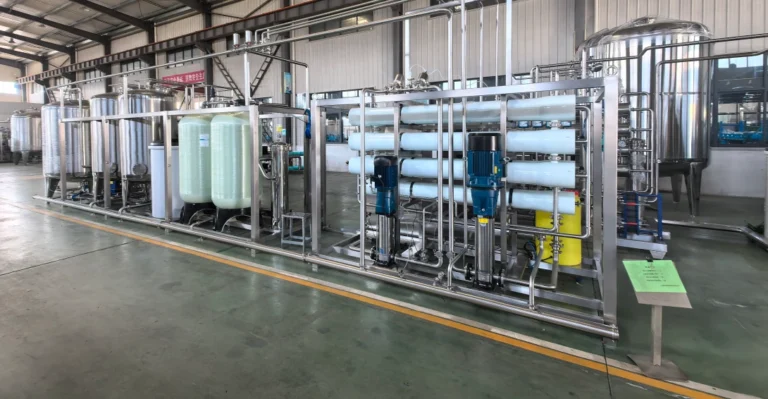
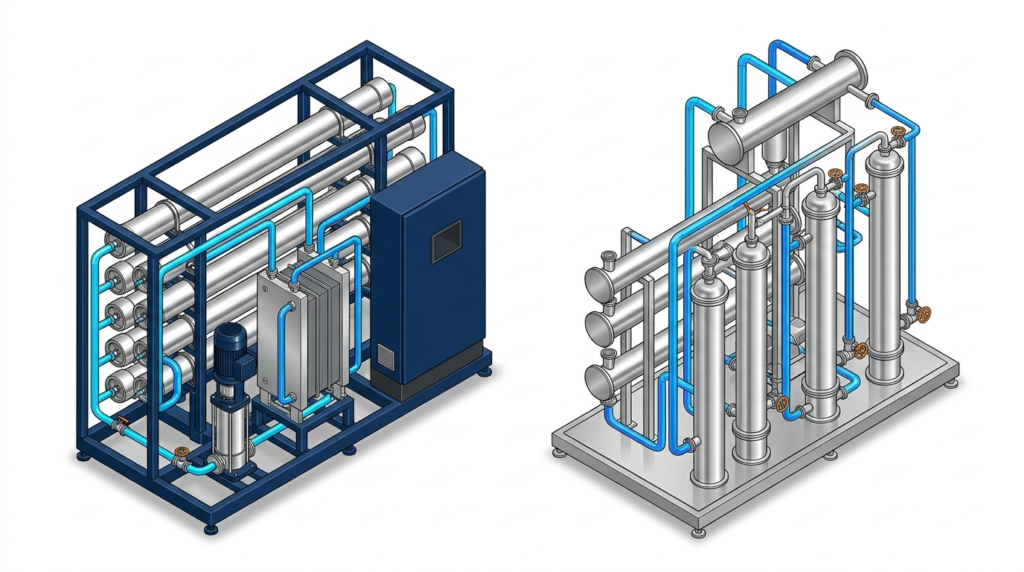
Purified water (PW) and water for injection (WFI) are two grades of water used to make drugs. PW serves products and cleaning steps that call for purified water. WFI is used to make drugs given by injection and for relevant final rinses of parts that touch the product.
Both grades need control of chemicals and microbes. WFI also needs control of bacterial endotoxins. Start with where the water will be used, then choose the grade. The machine, tank, pipes, and tests must all suit that choice.
PW and WFI at a Glance
| What to Compare | Purified Water (PW) | Water for Injection (WFI) |
|---|---|---|
| Main use | Products not given by injection, and cleaning where PW is specified | Drugs given by injection, and relevant final product-contact rinses |
| Chemicals and microbes | Both need limits and control | Both need limits and control |
| Bacterial endotoxins | Requirements depend on the use | A defined part of WFI quality |
| Water from the system | Bulk process water | Bulk process water; packaged sterile water is a separate product |
A grade describes the water you need. A process is how you make it. Reverse osmosis (RO), electrodeionization (EDI), and distillation are treatment methods. Their names alone do not prove a water grade. The chosen water system must keep making the required grade under the site’s actual working conditions.
Choose the Grade from the Job
The product and the point where water enters the process decide the grade. Medicines given by routes other than injection are called nonparenteral products. PW is used for these products and cleaning steps when PW is specified. WFI is used to dissolve or dilute ingredients in drugs made for injection. It also serves the final rinse of relevant equipment and parts that touch those products.
The table below is an illustrative map of three uses in a plant. It shows how one site can need both grades. Here, feed water means the water sent into the next machine.
| Where the Water Is Used | Grade in This Example | What This Means for the Plant |
|---|---|---|
| Mix a non-injectable product whose process calls for PW | PW | Supply PW to that use point through its PW tank and loop. |
| Feed the WFI distiller shown in the route below | Qualified PW feed | Size the upstream PW supply for the distiller as well as other PW demand. Plan steam, cooling, and a separate WFI tank and loop. |
| Dissolve or dilute ingredients for an injectable drug, or give relevant product-contact parts their final rinse | WFI | Make WFI and preserve its quality through storage and the loop to those use points. |
For example, water from the PW system can go to a PW use point or feed the WFI distiller. At the distiller inlet, it is still PW feed. The next process must produce the WFI needed downstream. Treating the WFI use point as a direct PW use would leave out the distiller and the WFI tank and loop.
Bulk WFI and Packaged Sterile Water Are Different Products
Bulk WFI is water used during drug manufacture. Packaged sterile water is a finished product. A bulk WFI system makes process water; a line that fills and seals sterile packs also needs its own filling, packaging, and finished-product sterility controls. Keep those tasks separate when you decide what to buy.
What Each Water Test Tells You
Each test checks a different part of water quality:
- Electrical conductivity measures how readily water carries an electric current. Dissolved ions affect the reading, so it helps assess chemical quality.
- Total organic carbon (TOC) measures carbon from organic matter in the water. It checks a different part of chemical quality.
- Microbial tests count microbes in a sample taken at a named point. Counts are expressed in colony-forming units (CFU).
- Bacterial endotoxin tests look for endotoxins, measured in endotoxin units (EU). These are parts of the outer membrane of Gram-negative bacteria and can cause fever.
| Water Quality Measure | Purified Water (PW) | Water for Injection (WFI) |
|---|---|---|
| Electrical conductivity at 25°C (Stage 1, not temperature compensated) | ≤1.3 µS/cm | ≤1.3 µS/cm |
| Total organic carbon (TOC), reference-solution carbon level | 500 µg C/L | 500 µg C/L |
| Microbial count, action level | 100 CFU/mL | 10 CFU/100 mL |
| Bacterial endotoxins | Set by process use | <0.25 EU/mL |
For conductivity, use the reading at the water’s measured temperature without a software temperature correction. A reading above the Stage 1 value moves to Stage 2 testing.
For TOC, subtract the reagent-water blank from the 500 µg C/L reference response. The sample response must not exceed that corrected value.
Exceeding a microbial action level calls for investigation and corrective action. The two grades share the chemical benchmarks shown, but microbes and endotoxins still need separate checks.
For example, suppose a water report shows conductivity and TOC within their limits. It lists no microbial or endotoxin test. You have evidence for the chemical checks shown at that sample point, but still need the other results to assess WFI. A microbial count cannot stand in for an endotoxin result.
Some microbial tests need time for microbes to grow before the result can be read. The water may have been used by then. Keep the process under control while tests build a record of how it runs.
Set limits for the required grade and keep results over time. Check the water during use as well as when the equipment is first accepted. The test plan must also say where online instruments and sample points are placed.
How the Two Example Routes Work
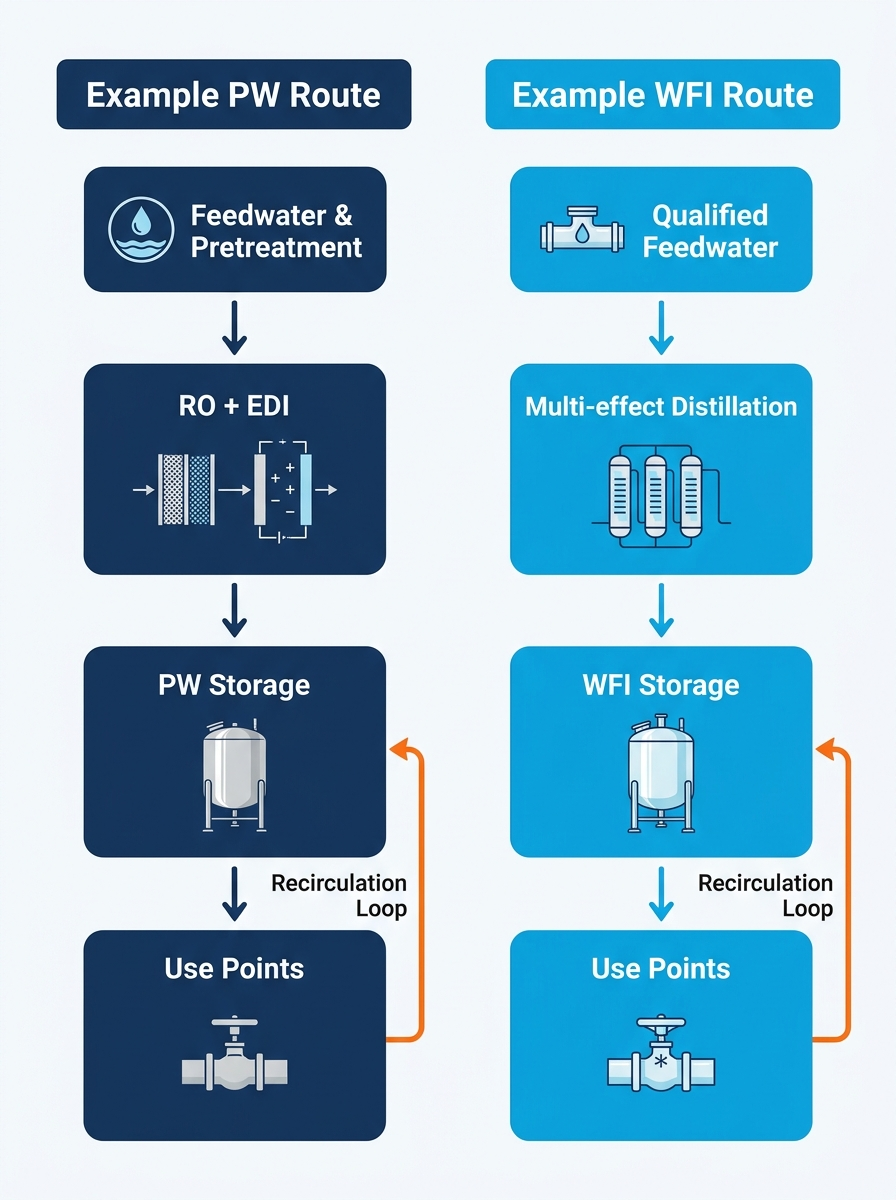
PW can be made with a suitable purification process. Choose the steps from the feed-water test and the quality needed at the outlet. The diagram shows an RO/EDI route for PW and a multi-effect distillation route for WFI.
PW: Prepare the Feed, Then Treat It with RO and EDI
Pretreatment removes things that could harm the main treatment stages. Each step has a job:
- Multimedia filters trap sand, silt, and other suspended matter.
- Activated carbon takes out chlorine left in the feed water. It can also remove some organic matter.
- A softener removes calcium and magnesium ions that make water hard. This helps protect RO membranes from scale.
- Cartridge filters with a 5 µm rating catch particles before they reach the RO membranes.
Use the feed-water test to choose these steps. A site may not need them all.
RO uses membranes to separate water from contaminants. In a two-pass RO system, water from the first pass goes through a second RO pass. EDI then takes out dissolved ions left in the water.
Ultraviolet (UV) light at 254 nm can be used to inactivate microbes. It is one part of the plan to control microbes. The whole water system, including its tanks and pipes, also needs sanitization and tests. NINGRUI’s purified water systems include pretreatment and RO/EDI options chosen for the project.
WFI: Heat the Feed, Remove Drops, and Collect Water
Multi-effect distillation (MED) uses a series of heated stages, called effects:
- Warm the prepared feed. Heat recovered from the process helps preheat the water before it enters the distiller.
- Turn water into vapor. Heating steam supplies heat to the first effect. Later effects reuse heat from earlier stages.
- Remove drops from the vapor. The vapor can carry small drops of feed water. Those drops can hold contaminants, so separation devices remove them before the vapor is cooled.
- Cool the vapor to form water. The vapor condenses into liquid water. The collected liquid is called distillate.
Impurities that do not readily enter the vapor build up in the water left behind. These are called nonvolatile impurities. Blowdown drains this concentrated water out of the unit.
The feed water, heating steam, and cooling must suit the chosen distiller. Its output rate and hours of use must match demand and the tank it serves. The upstream PW system is a separate piece of equipment from the WFI unit.
NINGRUI’s current WFI generation equipment uses MED.
Other Routes Can Also Make WFI
WFI can be made by distillation or another process that removes chemicals and microbes as well or better.
Non-distillation WFI routes can combine RO with other stages. Plans must cover the feed, each treatment step, samples, and ongoing control. Qualify and validate the system: check that it suits its task and keeps making the required water grade.
An RO/EDI label alone does not prove that the water is WFI. Evidence must cover the full water system and how it runs. These other routes are part of the wider technical field; NINGRUI’s current WFI supply here remains MED.
Why the Tank and Loop Matter
A tank holds water until users need it. It gives a reserve when they draw water faster than the unit can make it. Choose the useful tank volume to match how much water is drawn, and when. Allow time to make more water and sanitize the system. A bigger tank adds reserve but can also keep water in storage longer.
The pipe loop takes water from the tank to use points and back to storage. Flow helps keep water from standing still. Layout and drainage also matter. Include the tank vent, pumps, valves, pipe branches, and use-point connections in the plan to control microbes.
Hot storage and recirculation above 70°C are one way to limit microbial growth. The water system also needs a set plan for heat or chemical sanitization. The chosen method must reach the parts it is meant to treat and suit their materials. Define how to check that the method works.
Example: Water Left in a Branch
For example, suppose a sample meets its limits at the machine outlet. The water then sits in a pipe branch that drains poorly. The outlet result cannot tell you that water at this use point is fit to use.
Place instruments and take samples where they can check quality along the water’s path. The plan can include the generator outlet, tank, loop return, and relevant use points. A test result needs a location as well as a value.
NINGRUI’s water storage and distribution equipment covers the tank and loop equipment. It must work with the water-making unit and any tanks or site pipes kept in service.
Define the Supply Before Comparing Prices
Equipment and pipe connections. A quote for a water-making unit may leave out the tank, loop, and instruments. Align those items before comparing prices. State who supplies each part and who connects the feed water, steam, cooling, and outlet to storage.
Tests and proof. Agree who provides tests, records, and qualification support. Qualification uses documented checks to show that equipment is fit for its intended use. An equipment list alone does not assign these tasks.
A change from PW to WFI. Review the water-making unit, tank, loop, tests, and qualification together. Changing the unit alone leaves the storage and use-point needs unresolved. The water grade sets the quality requirements; the supply agreement states who provides each item.
Share the water uses and whether you need generation equipment, storage and distribution, or both. NINGRUI supports equipment selection and package coordination. Discuss Your Water System Requirements.
To prepare the quotation inputs, use the purified water system quote checklist.